 23Sep
23Sep
Pushkar Camel Fair 2026: Complete Travel Guide for International Visitors
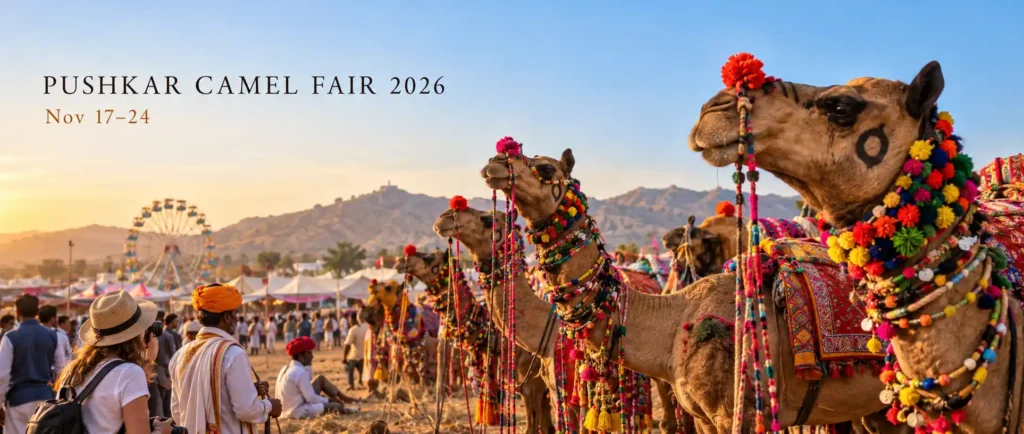
If you have seen photographs of Pushkar during camel fair season, you may already have an idea of what to…
Read Article
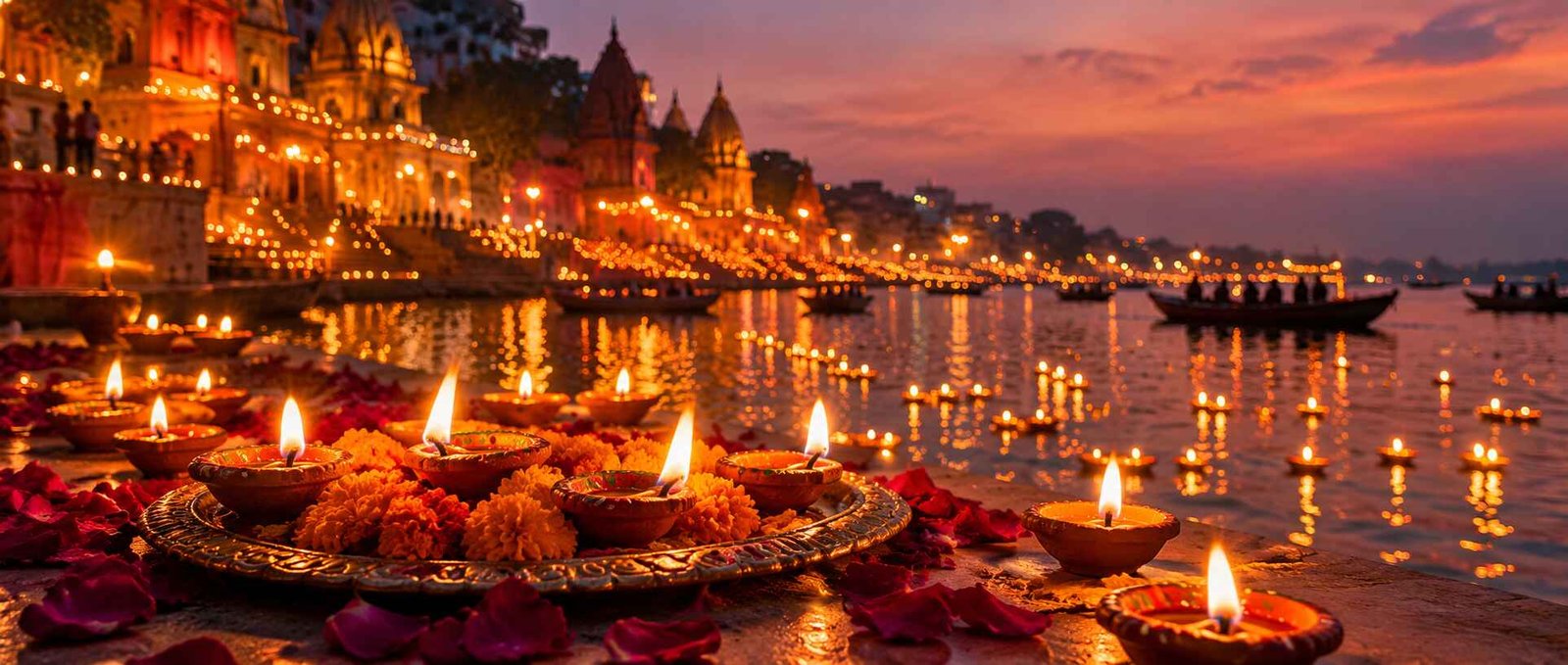
If you are planning to experience Diwali in India, the first decision is not simply where the biggest celebration takes place. It is what kind of Diwali you want to experience.
Ayodhya is associated with its large-scale Deepotsav and record-setting diya displays. Varanasi offers a different experience through Dev Deepawali, when the ghats of the Ganga are illuminated on Kartik Purnima, about 15 days after Diwali. Jaipur combines Diwali with historic bazaars and the wider Golden Triangle experience, while Amritsar brings Diwali-period celebrations together with the Sikh observance of Bandi Chhor Divas. Kolkata celebrates Kali Puja during the same period, while cities such as Udaipur, Delhi and Mysuru offer their own regional versions of the festival.
For international travelers, the dates matter as much as the destination. In 2026, Diwali falls on 8 November, Ayodhya Deepotsav is listed for 6 November, and Varanasi’s Dev Deepawali is listed for 24 November.
| If you want to experience… | Destination to consider |
|---|---|
| A record-setting diya display | Ayodhya |
| Illuminated Ganga ghats and Dev Deepawali | Varanasi |
| Heritage, bazaars and a classic North India itinerary | Jaipur |
| Diwali alongside Sikh traditions | Amritsar |
| Lakes, palaces and a more relaxed setting | Udaipur |
| A major metropolitan Diwali | Delhi |
| Kali Puja and Bengal’s Diwali traditions | Kolkata |
| A South Indian interpretation of Deepavali | Mysuru |
This is not a ranking. Each destination offers a different type of festival experience.
Diwali, also called Deepavali, is one of India’s major festivals and is observed in different forms across several religious and cultural traditions. The name is commonly associated with a row or series of lamps, reflecting the central role of diyas in the festival.
For many Hindus, Diwali is connected with the return of Lord Rama to Ayodhya after his exile, as described in the Ramayana tradition. In other parts of India, the festival has different associations. Some communities connect it with Goddess Lakshmi, the deity associated with prosperity; others observe stories involving Krishna and Narakasura. Jain communities associate Diwali with Mahavira’s liberation, while Sikh observances around the same period include Bandi Chhor Divas.
This regional variation matters when planning a trip. There is no single “Indian Diwali” that looks exactly the same everywhere.
The festival usually forms part of a sequence of days rather than a single evening. Dhanteras is associated with purchases and preparations; Naraka Chaturdashi is observed in many regions; the main Diwali night includes prayers, lamps and family gatherings; and subsequent days include Govardhan Puja and Bhai Dooj in many Hindu communities.
Food, family visits, prayers, decorations, gifts and lighting are common parts of the festival, but the customs differ from one region to another.
For a traveler, this means that the destination determines much of what you will actually see. In Ayodhya, the Ramayana connection is central to the festival atmosphere. In Varanasi, the major riverfront spectacle comes later with Dev Deepawali. In Kolkata, Kali Puja is an important part of the Diwali period. In Amritsar, the same period is associated with Bandi Chhor Divas and the illumination of the Golden Temple.
Diwali is therefore better understood as a festival season with strong regional identities, rather than one standardized event.
Ayodhya is particularly significant during Diwali because of its association with Lord Rama and the city’s modern Deepotsav celebrations.
The scale of the event has grown dramatically. At Deepotsav 2025, Guinness World Records recorded 2,617,215 oil lamps in Ayodhya, making it the world’s largest display of oil lamps under that record category at the time of verification. The lamps were arranged across 56 ghats, and Guinness says more than 30,000 volunteers were involved.
| Year | Recorded oil lamps |
|---|---|
| 2021 | 941,551 |
| 2022 | 1,576,955 |
| 2023 | 2,223,676 |
| 2024 | 2,512,585 |
| 2025 | 2,617,215 |
The important point for travelers is that the record itself is only one part of the experience. The event takes place around the Saryu riverfront, while the wider city hosts religious ceremonies and cultural activities.
Expect large crowds, substantial pedestrian movement and significant demand for accommodation and transport around the festival period.
If you want to see the main diya display, your day should not be planned around arriving shortly before the lighting ceremony. Build in time for security procedures, walking and crowd movement.
The closest hotel is not automatically the most convenient hotel during Deepotsav.
For international visitors, arranging transport and accommodation together can make the festival easier to manage.
Ayodhya during Deepotsav is very different from an ordinary sightseeing visit. Travelers have to deal with crowds, walking, security arrangements and changes to normal transport access, but the scale of the festival can also become one of the most memorable parts of an India itinerary.
Awesome Jaipur tour on lighting festival – Diwali – Anita Jain, India, Nov-2015
I visited the pink city- Jaipur on the eve of Diwali. Just cannot explain how mesmerized and awe-struck I was with the lighting and joy of festivities around the city. One could hear the crackers bursting everywhere and the night sky was continuously lit with the fireworks. People were dressed beautifully in ethnic attires and the homes were all lit with earthen diyas and electric lights. I would say if someone has to visit Jaipur then it should be around Diwali. You will not be able to forget this experience for a lifetime.
Memorable Diwali Festival Tour – Johnson, India, Oct-2014
We had a great time on this tour of Jaipur. This was a short trip and especially planned to enjoy the festivities of Diwali. I saw a lot of pics, heard about this festival from my Indian friends, and decided to visit India this year to be a part of the light festival. I reached Jaipur on 23rd October evening. The entire city was lit beautifully and people were enjoying fireworks. Our Hotel was also decorated with flowers, lights and Rangoli made with dry colors. We participated in Diwali puja and had a mouthful of Indian delicacies. In all it was marvelous and memorable trip for me and my friend. I want to thank my Indian buddy who told me about this beautiful festival and thanks to Maharaja Trails for organizing this beautify trip for me at such a short notice.
Uttar Pradesh tourism data reported 26,048 foreign tourist visits to Ayodhya in 2024, compared with 8,468 in 2023. These are annual destination figures, not Diwali-specific visitor numbers.
That distinction is important. It would be misleading to describe those figures as the number of foreign travelers who visited Ayodhya specifically for Deepotsav.
The official Incredible India listing currently gives 6 November 2026 for Ayodhya Deepotsav. Because event arrangements can change, travelers should verify the final program, access arrangements and public-entry information before traveling.
Varanasi offers a different festival experience.
The key date to understand is not Diwali itself, but Dev Deepawali.
According to India’s Ministry of Tourism’s Utsav portal, Dev Deepawali is celebrated approximately 15 days after Diwali, and the ghats become illuminated with lamps, prayers and other cultural activities.
The 2026 Incredible India listing gives 24 November 2026 for Dev Deepawali in Varanasi.
| Diwali | Dev Deepawali |
|---|---|
| Main festival of lights | Later Kartik Purnima celebration |
| 8 November 2026 | 24 November 2026 |
| Celebrated across India | Particularly associated with Varanasi’s ghats |
| Family prayers, lamps and local traditions | Riverfront lamps, prayers and cultural programs |
This distinction is one of the most important things an international traveler should understand before booking a Varanasi trip.
You can visit Varanasi during Diwali, but if your main goal is to see the famous illuminated ghats associated with Dev Deepawali, you need to plan around the later date.
The setting does much of the work. The festival takes place around the Ganga and its historic ghats. Visitors can see the riverfront illuminated with lamps, while prayers, music and other cultural activities take place around the city.
A boat can provide a different viewing perspective, but arrangements should be made carefully because demand can be very high.
Three broad areas can make sense for different travelers.
During Dev Deepawali, do not choose accommodation purely by looking at the distance on a map. Ask how your vehicle will reach the property during the festival.
Planning a Varanasi trip is often easier when you know what other travelers actually noticed once they arrived. Customer experiences can add a practical perspective that destination descriptions and statistics cannot provide.
The best option to travel in India! – Sersie, Portugal, Oct-2025
Our trip through India – from Varanasi, New Delhi, Agra, Jaipur, Jodhpur to Udaipur – was simply perfect.
Everything was extremely well organized, and we always felt safe and well taken care of. The company showed great responsibility, professionalism, and attention to every detail. What impressed us most was the kindness and genuine care of the entire team – always ready to help, always with a smile. Thanks to their coordination, we could enjoy India peacefully and experience its beauty to the fullest. We highly recommend their services to anyone looking for a reliable, honest, and truly exceptional travel company in India.
Golden triangle and Varanasi – Hungry, Washington, Feb-2019
We were very satisfied with our 7 day tour. As mentioned in the other reviews Jitendra was a very conscious tour operator. All drivers and guide were on time and very responsible. As we are two senior ladies we appreciated him checking daily to make sure everything was working for us. We asked for better hotels and we were happy with our accommodations. We especially enjoyed the culture of Varanasi and were very happy we added that part on. Thank you Jitendra !
Only retain statements in this list that are supported by your actual customer feedback or genuine company experience.
Varanasi recorded 309,932 foreign tourist visits in 2024, compared with 220,459 in 2023, according to Uttar Pradesh tourism data. Again, these are annual figures and should not be interpreted as Dev Deepawali attendance.
Instead of asking which destination is “better,” consider what you want to see.
| Factor | Ayodhya | Varanasi |
|---|---|---|
| Main festival focus | Deepotsav | Dev Deepawali |
| 2026 date | 6 November | 24 November |
| Main setting | Saryu riverfront and city | Ganga ghats |
| Major diya fact | Guinness-recognized 2025 record | Large-scale ghat illumination |
| Best suited to | Travelers interested in Ramayana traditions and Deepotsav | Travelers interested in Ganga, ghats and Dev Deepawali |
| Main planning issue | Crowd management and access | Crowd management, riverfront access and boat arrangements |
Do not describe Varanasi’s Dev Deepawali as holding Ayodhya’s Guinness record. The Guinness record cited in this article belongs to Ayodhya’s oil-lamp display.

Yes, but the two celebrations occur on different dates in 2026. If your objective is to experience Ayodhya Deepotsav on 6 November and Varanasi Dev Deepawali on 24 November, you would need a substantially longer itinerary with other destinations or activities between the two events.
If you have only a short trip, choose the festival that matches your interests rather than trying to include both.
For a broader India itinerary, the two cities can be combined with destinations such as Delhi, Agra and Jaipur, depending on the number of days available. See the Golden Triangle with Varanasi itinerary for an example of how the route can be structured.
Jaipur gives international visitors a different way to experience Diwali. The focus is less on a single giant public diya installation and more on the combination of decorated streets, markets, homes, heritage buildings and the city’s wider cultural setting.
Jaipur also works well for travelers who want to combine the festival with a conventional first-time India itinerary.
The main practical advantage is that Jaipur can fit naturally into a Delhi–Agra–Jaipur Golden Triangle itinerary. For first-time international visitors, the Golden Triangle India for First-Time Visitors guide also covers practical issues such as traffic, walking, transfer times and itinerary pacing.
For a first visit, consider whether you prefer central heritage areas, modern hotel districts, easy airport access, or proximity to the old city and markets. During Diwali, road congestion and market crowds can make a hotel that looks slightly farther away but has easier vehicle access a practical choice.
Amritsar demonstrates why a Diwali destination should not be evaluated only through Hindu festival traditions. Around the same period, Sikhs observe Bandi Chhor Divas. India’s Ministry of Tourism explains that the observance commemorates the release of Guru Hargobind Sahib and 52 princes from Gwalior prison. The Golden Temple is illuminated and religious activities take place during the celebration.
For visitors, the significance is cultural as well as visual. The Golden Temple, the surrounding complex and the atmosphere around Amritsar provide a very different experience from Ayodhya’s Deepotsav or Varanasi’s Dev Deepawali.
Udaipur offers a more compact setting for travelers who want to combine Diwali with Rajasthan’s palace and lake scenery.
During Diwali, homes, shops and public areas are decorated with lamps and lights. Udaipur can work well for travelers who want festival atmosphere without making the entire trip revolve around a single mass gathering.
Travelers considering Udaipur as an extension of the Golden Triangle can review the Golden Triangle with Udaipur itinerary to understand how the city fits into a longer private journey.
Delhi is useful for travelers who want to combine Diwali with a major Indian city rather than travel specifically for one festival venue.
Delhi is also a practical arrival or departure point for international travelers. If you are combining Diwali with the Golden Triangle, Delhi can serve as the starting point for a wider itinerary.
Kolkata is another reminder that Diwali does not look identical across India. During the Diwali period, Kali Puja is an important celebration in Bengal. The focus is on Goddess Kali, and temples and neighborhoods participate in the festivities.
For travelers interested in India’s regional diversity, Kolkata offers an opportunity to experience a Diwali-period tradition that differs significantly from the Ramayana-centered celebrations of Ayodhya.
Travelers who want to see how the festival changes outside North India can consider Mysuru.
Deepavali traditions in southern India differ in timing and local customs from those commonly associated with North Indian Diwali celebrations.
The lesson is simple: India’s festival calendar has regional variations, and choosing a destination based only on the word “Diwali” can result in a different experience than you expected.
Diwali experiences vary considerably from one Indian city to another. Customer feedback from Jaipur, Amritsar, Udaipur, Delhi and other destinations can help future travelers understand those differences from a visitor’s perspective.
Best Jaipur Visit – Danielle, Africa, Feb-2026
This trip we had transportation from Jaipur to Ranthambhore back to Jaipur for a stay and tour of the city! I always book through Maharaja Trails, because Jitendra provides the best drivers and very knowledgeable and personable tour guides. This time we had Abdul and Kamesh. This was my cousins first time in India and she loved everything about Jaipur! Thank you Jitendra
Memorable Golden Triangle and Amritsar – Viswanathan M, India, Nov-2018
We had a wonderful time.
Maharaja trails excelled in their arrangements.
The pick up and drop off at airport,
the hotels of stay, the assignment of good drivers and vehicles.
Lake city Rajasthan – Mobil, India, Oct-2024
We visited Udaipur with friends in October and all arrangements were made by Maharaja Trails. We are very happy with the services provided and highly recommended. Cheers !!
The best option to travel in India! – Giulia M, Brussels, Belgium, Mar-2020
After few days in Delhi for work I have decided to prologue my stay and go for a short golden triangle tour (Delhi-Agra-Jaipur). As a solo woman traveller I preferred to book an organized tour and I have to say I enjoyed the experience, even though I normally never take this kind of tours. Jitendra has always been really helpful and responsive. My driver Amrit has been always super available, driving carefully and ready to help at any time. Everything went smoothly.
Thank you very much Jitendra and Amrik! Great job!
(Source: https://www.tripadvisor.in/ShowUserReviews-g304555-d5288546-r751469696-Maharaja_Trails-Jaipur_Jaipur_District_Rajasthan.html)
These testimonials should focus on specific experiences rather than generic praise. A comment about a guide, transport arrangement, festival access, sightseeing pace or local experience gives future travelers more useful information than a statement such as “We had an amazing trip.”
Do not assume every Diwali-related event happens on the same day. For example: Diwali 2026: 8 November; Ayodhya Deepotsav: 6 November; Varanasi Dev Deepawali: 24 November. Check official event information before finalizing flights and hotels.
Festival-period demand can be substantially different from normal tourism demand. This is particularly relevant in Ayodhya and Varanasi.
A hotel may be geographically close to an event but difficult to reach by car during peak periods. Ask where the vehicle can drop you, how far you will walk, whether roads are restricted, and what time you should leave.
Do not plan a festival evening as though it were an ordinary sightseeing day. Keep your schedule lighter.
You may spend much more time walking than expected, especially around ghats, old-city lanes and crowded festival areas.
Digital payments are widespread in India, but having some cash remains practical for small purchases, local vendors and situations where connectivity or payment acceptance is inconsistent.
Festival photography can be rewarding, but religious ceremonies are not staged performances. Avoid blocking paths, pushing into restricted areas or photographing people at close range without considering privacy and context.
Diwali can be noisy, particularly at night. Travelers sensitive to noise should consider accommodation location carefully.
Fireworks can affect local air quality. Travelers should check current conditions and plan accordingly.
The most useful Diwali itinerary is rarely the one with the largest number of sightseeing stops. Leave room for traffic, crowds and unexpected delays.
| Destination | Accommodation consideration |
|---|---|
| Ayodhya | Balance proximity to festival areas with road access |
| Varanasi | Decide whether riverfront proximity or easier vehicle access matters more |
| Jaipur | Consider old-city access versus modern hotel areas |
| Amritsar | Staying near the Golden Temple can simplify sightseeing, but expect crowds |
| Udaipur | Lake/heritage areas provide a different atmosphere from outer hotel districts |
| Delhi | Choose based on your sightseeing route and transport connections |
| Kolkata | Consider access to major Kali Puja areas while allowing for city traffic |
| Mysuru | Central locations can simplify access to major sights |
During a major Indian festival, “near the attraction” and “easy to reach” are not always the same thing.
Arrival, Old Delhi, major monuments and preparation for the festival period.
Taj Mahal and Agra Fort. For practical Taj Mahal planning, see the Taj Mahal Sunrise Visit guide and the Taj Mahal Travel Tips guide.
Heritage sites, markets and the Diwali atmosphere.
Choose based on your festival date and priorities.
Add additional destinations such as Udaipur, Kolkata or southern India depending on your interests.
If your primary objective is Ayodhya Deepotsav, build the itinerary around 6 November 2026. If your primary objective is Varanasi Dev Deepawali, build it around 24 November 2026. Do not try to force both into a short holiday simply because they are both associated with Diwali.

Diwali can be a good period for travelers who want to see Indian cultural and religious traditions in an active, rather than purely museum-based, setting. But it is not the easiest period for every traveler.
The reward is that you can see traditions that are difficult to understand from a standard sightseeing itinerary alone.
Quick answers related to this article.
Important destinations include Ayodhya, Varanasi, Jaipur, Amritsar, Udaipur, Delhi, Kolkata and Mysuru. They should not be treated as identical experiences: Ayodhya is known for Deepotsav, Varanasi for Dev Deepawali, Amritsar for Bandi Chhor Divas alongside Diwali-period celebrations, and Kolkata for Kali Puja.
Ayodhya holds the Guinness World Records title for the largest display of oil lamps, with 2,617,215 lamps recorded during Deepotsav 2025.
Diwali is listed for 8 November 2026.
The official Incredible India listing gives 6 November 2026 for Ayodhya Deepotsav.
The official Incredible India listing gives 24 November 2026 for Dev Deepawali in Varanasi.
No. Dev Deepawali in Varanasi is a later celebration associated with Kartik Purnima and is generally observed about 15 days after Diwali.
Yes, travelers should expect very high visitor numbers around major Deepotsav events and should plan accommodation, transport and walking time accordingly.
For major festival destinations such as Ayodhya and Varanasi, early planning is sensible because accommodation and transport demand can increase significantly around the event dates.
Yes. International visitors can travel to Ayodhya, although festival-day access arrangements, security measures and transport restrictions should be checked before arrival.
The answer depends on the experience you want. Ayodhya is centered on Deepotsav and its large diya display, while Varanasi's major illuminated-ghat celebration is Dev Deepawali, which occurs later.
Diwali travel in India is easier when the festival itself becomes part of the itinerary rather than an event added at the last minute.
If you want to experience Ayodhya Deepotsav, Varanasi Dev Deepawali, Jaipur's Diwali atmosphere or a combination of destinations, plan the route around the relevant festival date, accommodation location, transport access and time needed for sightseeing.
Planning an India itinerary around Diwali? Turban Adventures can help you coordinate festival dates, accommodation, private transfers, guides and sightseeing into one practical journey.
23Sep
If you have seen photographs of Pushkar during camel fair season, you may already have an idea of what to…
Read Article 21Sep
21Sep
Planning a Golden Triangle trip and wondering whether you need 5, 7 or 10 days?The short answer is: 5 days…
Read Article 14Sep
14Sep
Delhi, Agra and Jaipur can be visited throughout the year, but the experience changes considerably from one season to the…
Read Article