 21Sep
21Sep
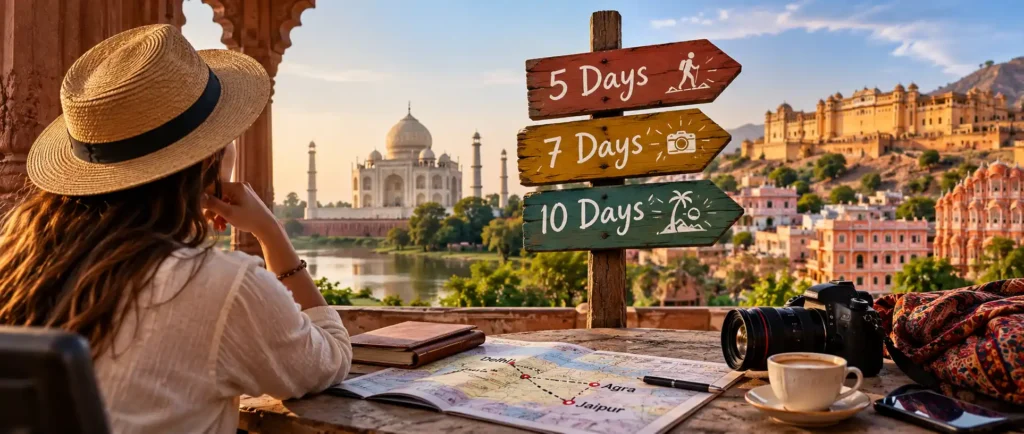
How Many Days Do You Need for the Golden Triangle? 5, 7 or 10 Days?
Planning a Golden Triangle trip and wondering whether you need 5, 7 or 10 days?The short answer is: 5 days…
Read Article
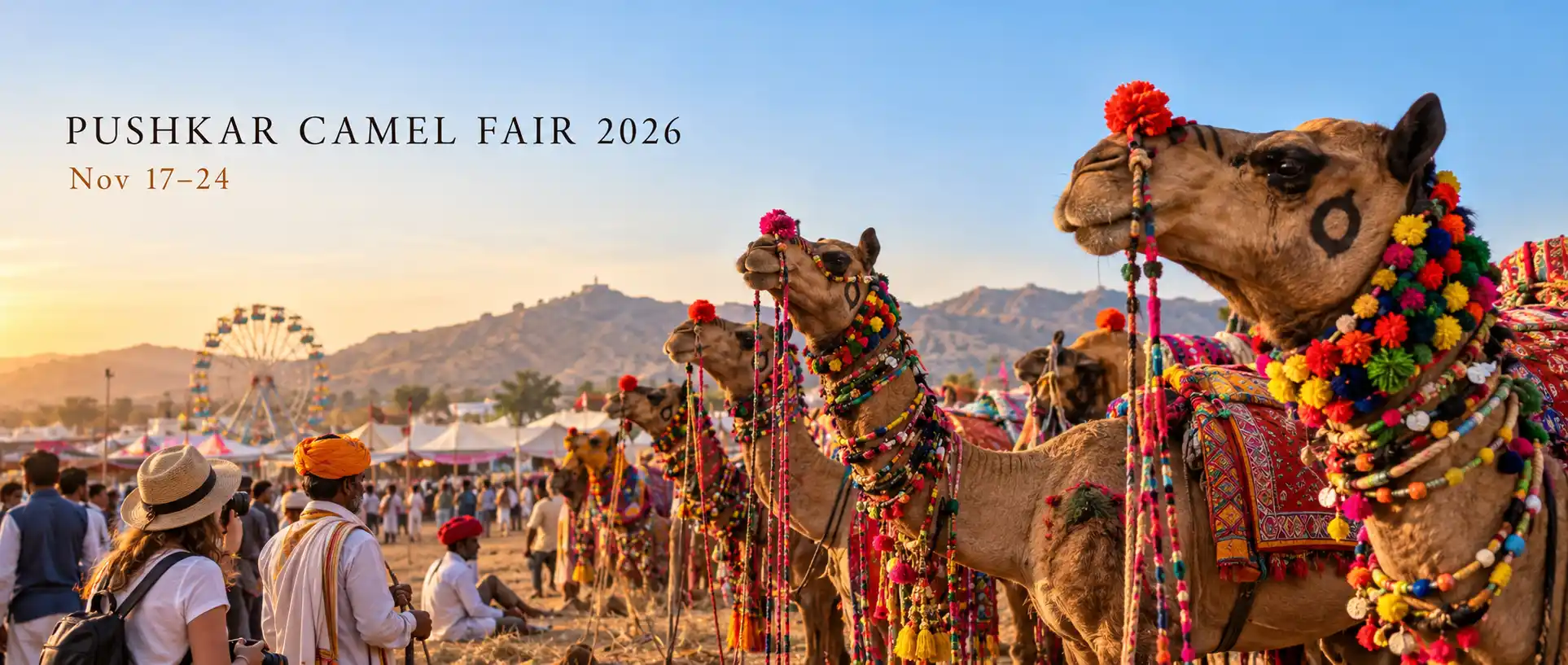
If you have seen photographs of Pushkar during camel fair season, you may already have an idea of what to expect: decorated camels, colorful turbans, Rajasthan’s traditional clothing, desert landscapes and crowds around Pushkar Lake.
But photographs do not tell the whole story.
The Pushkar Camel Fair, also known locally as Pushkar Mela, brings together livestock trading, religious traditions, cultural performances, competitions, markets and everyday life in one small Rajasthan town.
For an international visitor, that combination is what makes Pushkar particularly interesting. You can spend the morning watching camel owners prepare their animals, walk through the fairground, explore Pushkar’s old streets and temples, and later sit beside the lake while pilgrims carry out religious rituals.
The 2026 Pushkar Fair is scheduled for November 17–24, 2026. Rajasthan Tourism describes it as an annual camel and livestock fair that has developed into a major tourist attraction, while Incredible India also lists the 2026 dates and states that there is no admission ticket for the fair itself.
| Festival | Pushkar Camel Fair / Pushkar Mela |
|---|---|
| Dates | November 17–24, 2026 |
| Location | Pushkar, Rajasthan |
| Main focus | Camels, livestock, culture, religion and local traditions |
| Fair entry | No general admission ticket listed by Incredible India |
| Nearest major city | Jaipur |
| Nearby destination | Ajmer |
| Best for | Culture, photography, festivals, Rajasthan experiences |
| Good trip length | 1–2 nights for most international visitors |
| Best strategy | Combine Pushkar with Jaipur and Ajmer |
The dates above are based on the current official Rajasthan Tourism and Incredible India listings. Festival programs and individual events can change, so check the official schedule closer to your travel dates.
The Pushkar Camel Fair is much more than a tourist event featuring camels.
Historically, Pushkar has been an important gathering point for livestock traders and rural communities. During the fair period, the town becomes a meeting place for camel and livestock owners, pilgrims, traders, performers, photographers and visitors from India and abroad.
Rajasthan Tourism describes the fair as a camel and livestock event that has also become a major tourist attraction, with competitions such as the longest moustache, matka phod and bridal competitions.
For visitors, the easiest way to understand Pushkar Fair is to think of it as three experiences happening at the same time:
This is the traditional side of Pushkar.
Camel owners arrive with their animals, and you may see animals being washed, groomed, decorated and prepared for trading or competitions.
The fairground becomes a place for performances, competitions, markets and other activities.
The exact program varies by year, but Rajasthan Tourism has historically included activities such as moustache competitions, matka races, cultural performances and events involving foreign visitors.
Pushkar is also one of India’s important Hindu pilgrimage towns.
The spiritual side centers around Pushkar Lake, its ghats and the temples surrounding the town.
This is one reason the fair can feel very different from a conventional cultural festival.
Not every day of the Pushkar Fair feels the same.
If your main interest is photography, you may want to spend more time around the camel camps and fairgrounds.
If you are interested in religion and local traditions, you should leave enough time for Pushkar Lake and the temples.
If you want to see the larger cultural program, check the official event schedule for the dates of specific competitions and performances.
| Your main interest | Give priority to |
|---|---|
| Camels and livestock | Early fair days and livestock areas |
| Photography | Early mornings and late afternoons |
| Cultural performances | Scheduled fairground events |
| Religion | Pushkar Lake, ghats and temples |
| Shopping | Fair markets and Pushkar bazaars |
| Relaxed sightseeing | Early morning or later afternoon |
Don’t build your entire trip around a single advertised event unless that event has been confirmed for your travel date.
A typical visit can include much more than walking around looking at camels.
The livestock area is where you can see one of the fair’s most distinctive sides.
Owners spend considerable time preparing their animals. Camels may be cleaned, groomed and decorated before being presented to buyers or visitors.
For someone visiting Rajasthan for the first time, this can be a very different experience from visiting a monument.
Rajasthan Tourism lists traditional competitions including moustache contests and matka phod, while fair programs can include cultural performances and other competitions.
Pushkar’s streets and fair areas become busy with textiles, handicrafts, jewelry, clothing, religious items and food.
Prices are not necessarily fixed in every market environment, so ask politely before buying and compare a few items if you are shopping for souvenirs.
As the fair period approaches its religious culmination, Pushkar Lake becomes particularly important for pilgrims.
Visitors should remember that this is not simply a photographic backdrop.
Pushkar is one of those places where the best photographs often happen away from the obvious stage.
Early morning is particularly useful because the light is softer and the livestock areas can feel less hectic.
Always ask before taking a close-up portrait of someone.
Pushkar Lake is central to understanding why Pushkar is more than a camel fair.
The lake is surrounded by ghats where pilgrims carry out religious rituals. The atmosphere here can be considerably quieter and more reflective than the fairground.
Incredible India notes that pilgrims come to Pushkar Lake for a holy dip and to seek blessings at the Brahma Temple.
For international visitors, this is an important distinction:
The fair is not the whole of Pushkar.
If you spend your entire visit at the camel grounds, you miss the religious and historical character of the town.
When visiting the ghats:
Pushkar is famous for its association with Lord Brahma, and the Brahma Temple is one of the town’s most important religious sites.
A visit makes sense even if religion is not the primary reason for your trip because it helps explain why Pushkar developed into such an important pilgrimage destination.
Combine the temple visit with time around Pushkar Lake rather than treating it as a quick photo stop.
One of the strongest parts of Pushkar is the variety of people who come together.
The fair is therefore not just something you watch.
For a short period, you are seeing different parts of Rajasthan’s rural, commercial, religious and tourist life sharing the same space.
If you have limited time, these are the experiences worth considering.
This is where expectations matter.
Pushkar during fair season is busy.
Roads can be slower. Hotels can fill quickly. Accommodation prices can rise during the fair period. The town can feel much more crowded than it does outside festival season.
At the same time, that activity is part of the reason to come.
You are not visiting a quiet resort town.
You are arriving during one of its busiest and most culturally significant periods.
If you prefer complete silence, predictable schedules and resort-style relaxation, Pushkar Fair may require some patience.
If you enjoy seeing a destination when local activity is at its peak, the atmosphere can be the main attraction.
The historical traveler reviews supplied for this article contain Pushkar-related experiences from 2014, 2015 and 2017 and refer to Maharaja Trails. Since these are older reviews, they should be presented as historical traveler feedback rather than as recent 2026 reviews.
The traveler visited Pushkar as part of a wider Rajasthan and India journey and wrote that it was a “great and very comfortable experience,” specifically mentioning organized transportation, good drivers and hotels.
What is interesting for someone planning Pushkar is that the review did not describe the destination in isolation. Pushkar was one part of a larger journey including Jaipur, Jodhpur and Mumbai.
What a new traveler can take from this: Pushkar works particularly well as part of a broader Rajasthan itinerary rather than necessarily as a stand-alone trip.
This review specifically mentions the Pushkar and Camel Fair experience.
“First time I saw a camel dance which I will not forget forever.”
The traveler also mentioned experiencing different colors of Rajasthan, local food and the atmosphere around Pushkar.
What a new traveler can take from this: the fair can produce memorable moments that are difficult to predict from a standard sightseeing itinerary.
This traveler described Pushkar as a religious experience and mentioned visiting Brahma Temple, Rangji Temple and Maa Savitri Temple.
“I found peace at Brahma temple.”
The traveler further mentioned comfortable accommodation and feeling safe during the trip.
What a new traveler can take from this: Pushkar is not only about camels. Its religious character can be an important part of the visit.
For a first-time international traveler, reviews like these answer a question that standard destination descriptions often don’t: What do people actually remember?
Accommodation deserves more attention than it normally receives because the Pushkar Fair changes the equation.
A hotel that is perfectly available on an ordinary November week may have different availability, rates or minimum-stay conditions during the fair.
Your choice generally falls into four categories.
| Stay style | Best suited to |
|---|---|
| Central Pushkar hotel | Travelers who want to walk around town |
| Heritage-style property | Travelers interested in atmosphere and character |
| Resort or larger hotel outside the busiest area | Travelers prioritizing comfort and space |
| Luxury/festival camp | Travelers looking for a more distinctive fair experience |
The advantage is obvious: less time spent getting to the fair.
The downside is that the busiest areas can be noisy and crowded.
This can provide a quieter evening and easier vehicle access.
For travelers who value sleep and comfort, this can sometimes be a better compromise than staying directly in the busiest part of Pushkar.
Pushkar and the surrounding area have properties with traditional Rajasthan architecture and heritage-style surroundings.
These can make the stay feel more connected to the destination.
Luxury tented stays are another option during festival season. Incredible India specifically highlights luxury tent accommodation as one way to experience Pushkar Fair.
Before booking, check exactly what is included: meals, transfers, heating/cooling arrangements, bathroom facilities, Wi-Fi and cancellation conditions can differ considerably.
One useful example is RTDC Hotel Sarovar in Pushkar, operated by the Rajasthan Tourism Development Corporation.
The current RTDC listing shows a special tariff for November 17–24, 2026, corresponding with the Pushkar Fair. During this period, the listed tariff changes from the regular CP plan to a MAP plan, meaning room, breakfast and either lunch or dinner, with GST additional. The listing also states that the Pushkar Fair tariff has no discount applicable.
| RTDC Sarovar room category | Double occupancy |
|---|---|
| A.C. | ₹3,000 |
| A.C. Deluxe | ₹4,000 |
| A.C. Deluxe Sarovar View | ₹6,000 |
| A.C. Deluxe Heritage | ₹4,000 |
| A.C. Family | ₹5,000 |
| A.C. Super Deluxe | ₹5,000 |
| Non-A.C. | ₹2,500 |
These are the currently published RTDC rates for the November 17–24, 2026 fair period, and GST is additional. Rates and availability can change, so travelers should confirm directly before booking.
The important lesson isn’t necessarily that you should stay at this particular hotel.
It is that Pushkar Fair should be treated as a special accommodation period, not as an ordinary November stay.
Before booking, ask yourself:
For international visitors on a multi-city itinerary, location and reliable transportation can matter more than having the most luxurious room.
The easiest international-traveler route is usually to connect Pushkar with other Rajasthan destinations.
A practical sequence is:
Delhi → Agra → Jaipur → Ajmer → Pushkar → Delhi
This is also the route used by the current Golden Triangle Tour with Ajmer and Pushkar offered by GTT Experts.
Ajmer is particularly useful because it sits close to Pushkar and provides an additional destination before continuing into Pushkar.
If you are traveling independently, you can also reach Pushkar from Jaipur by road.
For travelers arriving in India by international flight, Delhi is usually the easiest starting point if the rest of the trip includes the classic Golden Triangle.
Pushkar makes particular sense if your India trip already includes:
Delhi + Agra + Jaipur
You have already covered the major Mughal and Rajput monuments.
Pushkar then adds something different.
If you are planning your first Golden Triangle journey, our Golden Triangle guide for first-time travelers can help you understand how Delhi, Agra and Jaipur fit together.
For travelers who want the classic Golden Triangle plus Pushkar Fair, one practical route is:
Delhi → Agra → Jaipur → Ajmer → Pushkar → Delhi
GTT Experts currently offers a private 8-night/9-day Golden Triangle Tour with Ajmer and Pushkar following this general route. The package page lists private A/C transportation, hotel accommodation, daily breakfast, airport transfers, an English-speaking licensed guide and monument entrance fees.
See the Golden Triangle Tour with Ajmer and Pushkar.
The benefit of this type of itinerary during fair season is not simply having a driver.
It is having the inter-city transportation arranged while you focus on the destinations.
That can be particularly useful when Pushkar roads and accommodation are busier than normal.
Pushkar Fair is one of those trips where private transportation can be more useful than it first appears.
For first-time visitors, that removes several small logistical decisions.
It does not eliminate traffic or crowds, but it can make the overall journey easier to manage.
If you are comparing tour options, our 2026 Golden Triangle tour cost guide is useful for understanding what changes the price of a private itinerary, including hotel category, transportation and trip length.
The current GTT Experts package page lists:
Always confirm the final inclusions for your specific travel dates before booking because hotel availability and itinerary details can change.
The combination of Delhi, Agra and Jaipur provides the major landmarks, while Pushkar introduces a more local and festival-oriented experience.
Our Golden Triangle guide for first-time visitors also covers practical considerations such as road travel, sightseeing pace and what the journey between cities can feel like.
Pushkar offers a different atmosphere from the major cities, particularly around the lake and during sunset.
The combination of people, animals, clothing, landscapes and religious architecture creates plenty of visual variety.
Families may enjoy the fair, although parents should expect crowds and should plan transport and accommodation carefully.
If your interest in India goes beyond monuments, Pushkar is particularly relevant because the fair combines rural commerce, religion and tourism.
One reason Pushkar works well in a longer India itinerary is the contrast.
Delhi can feel enormous.
Agra is strongly associated with the Taj Mahal and Mughal history.
Jaipur introduces forts, palaces, bazaars and Rajput heritage.
Then Pushkar feels different again.
You may find yourself spending part of the day around camels and livestock, then walking beside a sacred lake, followed by dinner in a small restaurant or hotel.
For a traveler from the United States, United Kingdom, Australia or Europe, that change of pace can make Pushkar feel less like another sightseeing stop and more like an encounter with a living festival.
But it is worth keeping expectations realistic.
Pushkar is not a theme park built for international visitors. Some of the most interesting parts of the experience come from observing everyday activity respectfully rather than expecting every moment to be organized for tourists.
The historical traveler reviews supplied for this article reflect this variety. One visitor remembered the camel experience, another highlighted the religious atmosphere around Brahma Temple, and another described Pushkar as one part of a broader Rajasthan journey.
That variety is useful for a first-time traveler because there isn’t one single “correct” way to experience Pushkar.
| Traveler type | What may stand out |
|---|---|
| Photographer | Camels, people, colors and morning light |
| Culture traveler | Local communities, fair traditions and performances |
| First-time India visitor | A very different side of Rajasthan |
| Couple | Lake, markets and evening atmosphere |
| Family | Cultural activities and camel-related experiences |
| History traveler | Brahma Temple, Pushkar Lake and Ajmer |
| Luxury traveler | Heritage hotels, resorts and tented accommodation |
| Independent traveler | Flexibility to explore at your own pace |
Not everyone can stay two nights.
If your itinerary is tight, you can still see the highlights.
Don’t attempt to cover everything.
Morning: Fairground and camel areas
Late morning: Pushkar Lake
Afternoon: Lunch and rest
Late afternoon: Old town and markets
Evening: Cultural event or relaxed time around the lake
Two days gives you enough breathing room to experience both the fair and the town without making every hour a sightseeing appointment.
Three days can make sense if you want a slower Pushkar experience, photography time, a more relaxed fair visit and additional exploration around Ajmer.
Start early.
Visit the camel and livestock areas before spending the middle of the day exploring Pushkar town.
After lunch, take some time to rest.
Later in the afternoon, return toward the fairground when the light becomes more suitable for photography.
Finish the day around Pushkar Lake.
Visit Brahma Temple and the lake in the morning.
Explore local markets and smaller streets.
Use the afternoon for any fair activities you missed on Day 1.
If your itinerary permits, combine the Pushkar visit with Ajmer.
A three-day stay is useful for travelers who do not want to rush.
Day 1: Arrive, check in and explore the town.
Day 2: Spend most of the day around the Pushkar Fair.
Day 3: Explore Pushkar Lake, temples and markets, then continue to Ajmer or onward to Delhi depending on your itinerary.
This is particularly useful for photographers because you can return to the same areas at different times of day.
Pushkar should not be compared with Jaipur, Jodhpur or Udaipur as though they offer the same type of experience.
| Destination | Main character |
|---|---|
| Jaipur | Forts, palaces, architecture and bazaars |
| Jodhpur | Mehrangarh Fort and Blue City |
| Udaipur | Lakes, palaces and romantic scenery |
| Jaisalmer | Fort, desert and sandstone architecture |
| Pushkar | Pilgrimage, lake, fair culture and livestock traditions |
The choice depends on what you want from your Rajasthan trip.
Pushkar becomes particularly distinctive during the fair because the town itself becomes part of the experience.
November is already a popular Rajasthan travel period, and the fair adds another layer of demand.
The fair is not a quiet sightseeing experience.
You may spend considerably more time walking than expected.
Even in November, you should be prepared for strong daytime sun.
Not every small vendor or local establishment will accept international cards.
Stay hydrated, particularly while walking around the fairgrounds.
Do not assume an activity will happen every day at the same time.
Crowds and dust are practical concerns.
Festival travel rarely behaves exactly like a normal sightseeing day.
Don’t plan Pushkar as if it were just another monument visit.
A common mistake is to arrive, take a few camel photographs, visit the temple and leave.
That gives you only part of Pushkar.
Instead, allow time for the fairground, the lake, the town and the people.
The strongest memories may come from something you did not schedule.
Dress respectfully and follow local instructions.
Do not interrupt religious rituals for photographs.
Ask permission for close-up portraits.
Do not touch animals without permission.
Avoid photographing children simply because they look interesting or colorful without asking a parent or guardian.
A polite “No, thank you” is usually enough. You do not need to argue about every offer.
Yes, but it depends on what kind of experience you want.
Pushkar can be a strong addition to a first India trip because it introduces a different side of the country after the major monuments of Delhi, Agra and Jaipur.
At the same time, it can be busy, noisy and visually intense during the fair.
If you want a polished resort experience, choose your accommodation carefully.
If you want cultural variety and don’t mind some unpredictability, Pushkar can add something very different to a classic Golden Triangle itinerary.
The fair itself does not currently list a general admission ticket on Incredible India’s official 2026 information page.
However, individual activities, accommodation, transportation, food and optional experiences can have their own charges.
So “free entry” does not mean the entire Pushkar trip is free.
The answer depends on what you want from your India trip.
If your itinerary is focused entirely on famous monuments, Pushkar may not be essential.
If you want to see a festival where livestock traditions, pilgrimage, local culture and international tourism overlap, Pushkar offers something that Delhi, Agra and Jaipur cannot provide in quite the same way.
The most useful way to think about it is not:
“Should I see another tourist attraction?”
Instead, ask:
“Do I want to experience Rajasthan during one of its major cultural gatherings?”
If the answer is yes, Pushkar deserves serious consideration.
The current GTT Experts route combining Delhi, Agra, Jaipur, Ajmer and Pushkar is designed around exactly this contrast.
You get the major monuments of the Golden Triangle first, then move toward Ajmer and Pushkar for a different side of Rajasthan before returning to Delhi. The current package is listed as an 8-night/9-day private tour with private A/C transportation, accommodation, breakfast, airport transfers, an English-speaking guide and monument fees.
See the Golden Triangle Tour with Ajmer and Pushkar.
For travelers who want to understand the classic Golden Triangle before adding Pushkar, you can also read the complete Golden Triangle guide.
If you are still comparing itinerary costs, the Golden Triangle 2026 budget guide explains the major factors that affect private-tour pricing.
Pushkar Camel Fair 2026 is scheduled for November 17–24.
But the dates are only the starting point.
The real planning decision is how you want to experience Pushkar.
Come for the camels and you will see one part of it.
Stay long enough for the lake, temples, markets and local streets, and the destination becomes much more interesting.
Add it to a Delhi–Agra–Jaipur itinerary and it can provide a completely different rhythm after the major monuments of the Golden Triangle.
For international visitors, that contrast may be the biggest reason to include it.
Pushkar is not simply a camel fair. It is a short window into several different sides of Rajasthan happening in the same place.
Jitendra Singh is Co-Founder of GTT Experts and a Jaipur-based Golden Triangle travel specialist with 12+ years of experience planning private India journeys for international travelers. His work focuses on creating practical itineraries across Delhi, Agra, Jaipur, Rajasthan and other destinations in North India.
Useful official references:
Rajasthan Tourism fairs and festivals,
Incredible India: Pushkar Camel Fair, and
RTDC Hotel Pushkar Sarovar.
For more verified traveler feedback, visit the GTT Experts testimonials page.
Quick answers related to this article.
The Pushkar Camel Fair is scheduled for November 17–24, 2026. The dates are currently listed by both Rajasthan Tourism and Incredible India.
For most international travelers, one to two nights is a practical starting point. Photographers or travelers who want a slower experience may prefer two to three nights.
Pushkar adds a different type of experience to Delhi, Agra and Jaipur, particularly if you are interested in cultural festivals, photography, religion and rural Rajasthan.
Yes. Pushkar can be reached by road from Jaipur and is commonly combined with Ajmer.
Staying overnight gives you much more time and avoids turning the visit into a rushed day trip. During the fair, however, accommodation should be booked well in advance.
Yes. The combination of livestock, people, traditional clothing, markets, temples and landscapes offers considerable photographic variety. Always ask before making close-up portraits.
It can be, but families should prepare for crowds, walking and busy roads. Accommodation location and reliable transportation become particularly important.
Comfortable, breathable clothing is practical, but visitors should dress more conservatively around temples and religious areas.
Yes. Ajmer and Pushkar are close enough to be combined in the same travel day or itinerary.
No. The camel and livestock fair is one part of the experience. Pushkar Lake, Brahma Temple, markets, local food and religious traditions are also important.
They can be. Some properties publish special festival-period tariffs. For example, RTDC's Hotel Sarovar currently lists a separate November 17–24, 2026 Pushkar Fair tariff and states that its fair tariff has no discount.
21Sep
Planning a Golden Triangle trip and wondering whether you need 5, 7 or 10 days?The short answer is: 5 days…
Read Article 14Sep
14Sep
Delhi, Agra and Jaipur can be visited throughout the year, but the experience changes considerably from one season to the…
Read Article 07Sep
07Sep
Golden Triangle India for First-Time Visitors: What Nobody Tells You Before You Go Planning your first trip to India can…
Read Article